Harry Tracy: The Mackintosh Bandit
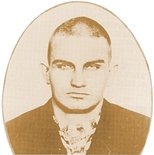
The sun hadn't been up long on June 9, 1902. Breakfast was over for the prisoners at the Oregon State Penitentiary. A group of prisoners had just been marched from the chapel to the stove foundry where they worked. F.B. Ferrel, a guard with a reputation for cruelty was in charge of the detail. Suddenly two prisoners broke away from the formation, grabbed rifles that they had hidden nearby and shot Ferrel to death. It was the beginning of the bloodiest jailbreak in Oregon up to that time.Thus was born the legend of Harry Tracy who would be idolized by a generation of young people as the Lone Bandit, the Oregon Badman, or King of the Western Robbers. In 1947 Stewart Holbrook, Oregon's great lowbrow historian debunked the myth, by telling the more-or-less true story of Tracy's pathetic career, but still Tracy is remembered as the one true western outlaw to operate in Portland.
Born Henry Severn in Pittfield, Wisconsin in 1874, Tracy dropped out of school at a young age. He drifted west to Wyoming where he hooked up with a gang of cattle rustlers who worked with Butch Cassidy and the Sundance Kid. Tracy preferred the city. In 1897 he was arrested for burglary in Salt Lake City. Never one to stay long in jail, Tracy soon escaped.
Tracy ran to Colorado where he joined the Hole-In-The-Wall gang. He was back to cattle rustling and highway robbery. In 1898 after the murder of a boy, William Strong, during a robbery, a posse went after the Hole-In-The-Walls. During a brutal gunfight, Valentine Hoy, a member of the posse was killed. Tracy was arrested along with three other gang members. One of the criminals was lynched. The other three were convicted of murder, one after being extradited to Wyoming.
Tracy went to jail in Aspen, Colorado, but escaped a short time later after nearly killing a guard with a lead pipe. This time he ran to Portland where he hooked up with Dave Merrill, the local bad-boy of Vancouver.
They committed their first crime together on January 3, 1899 when they held up the Second Street Trolley near College St. They got nearly $10 in change and a cheap watch. They robbed several saloons and grocery/butcher shops. Once they got nearly $100 in merchandise, but under $10 in cash. They actually missed $40 in gold during that robbery because they didn't search deep enough in the bartender's pocket.
By the beginning of February all of Portland was on the lookout for the Black Macintosh Bandit. The home of Dave Merrill's mother, on SW Front St. near Market, was under constant watch. On Sunday, February 5 the surveillance paid off. Dave Merrill was arrested after being found hiding in the bottom drawer of his mother's bureau with a gun. After intense questioning Merrill revealed that Tracy was expected to arrive in Portland on Monday.
That afternoon Detective Dan Weiner of the Portland police spotted Tracy, wearing his trademark black mackintosh, approaching Mrs. Merrill's house. As Weiner approached Tracy became suspicious and put his hand on a gun in his pocket. Weiner, without identifying himself, asked Tracy to walk up Market St. When they neared SW Fourth they saw the Southern Pacific passenger train coming up the street.
"I guess I'll take this train," said Tracy, "So long."
"I guess you won't," said the detective drawing his gun.
They exchanged shots and Tracy jumped onto the train. He jammed his gun into the engineer's ribs and told him to keep going. Weiner yelled for the train to stop, but the shooting had panicked the passengers and the Conductor thought Weiner was a robber at first. Finally he figured out that something was wrong and cut the air to the train's hydraulics.
Tracy jumped off the train near Montgomery St. Unfortunately for him, on that corner was Wey's Butcher shop that he had robbed only days before. Albert Wey, the 14-year-old son of the butcher, recognized the redheaded young robber and grabbed his father's shotgun. The shotgun was loaded with birdshot, but it hit Tracy right behind the ear, causing a terrible wound. Tracy crashed through a couple of yards before finally giving up.
Tracy was sentenced to twenty years. Merrill got 13. Tracy was cocky during his trial, complaining that Portland was a cheap town, hardly worth expenses. The Oregon State Penitentiary was not a nice place for cocky people at the turn of the twentieth century. Infractions were routinely punished at the lashing post with up to 150 lashes. The Oregon Boot, an infamous leg iron, was also used on unruly prisoners. It was no coincidence that Frank B. Ferrell was among the dead guards during Tracy's 1902 breakout. Many thought Tracy had killed him in revenge.
B.F. Tiffany and S.R.T. Jones, both guards, were also killed. Frank Inghram, a life prisoner who saved a guard's life by tripping Tracy during the jailbreak, was shot in the leg. Inghram's leg was later amputated and he received a pardon.
It was no surprise when Tracy broke out in 1902. He had done it many times before. Besides the Salt Lake City and Aspen, CO jails, he tried to break out of the Multnomah County jail during his trail. He stole a pistol, but never managed to leave his cell. He and Merrill both escaped from a train platform in Olympia, WA in December 1899 after being transported there to face charges. They were both free for New Years 1900, but were captured again in Portland a short time later.
The escape in 1902 was something else, though. Immortalized by a group of pulp fiction writers in the early decades of the Twentieth century as a desperate flight for freedom, it is hard to see it as anything else.Trigger-happy posses formed in every county between Salem and Olympia, WA and National Guard units were called out in both states. Bloodhounds were brought down from the Walla Walla prison and put on the trail.
Detective Joe Day of the Portland police, who participated in the manhunt, told Stewart Holbrook, "The whole damned country was full of militia, and many of the boys were potted. They shot at everything and Clark and Cowlitz counties sounded like the Spanish American War all over again. It was the most dangerous place I was ever in."
Tracy and Merrill had no trouble avoiding the posses and the rolling batteries of Winchester rifles that dogged them. They moved steadily north taking food and clothing from anyone they encountered. One time they even robbed members of the Marion Co. posse that was pursuing them.
Tracy killed Merrill near the town of Napavine, WA on the night of June 28. No one will ever know what really happened between them, but later Tracy told the driver of a boat he had hijacked that it had been a "duel." Evidence showed that Merrill had been shot in the back. Tracy would be responsible for 11 murders before he was finally run to ground.
The hijacked boat dropped Tracy off near Seattle, sending the gold rush city into a panic. Tracy slipped through the city and crossed the Snoqualmie Pass, before he was killed in a shoot out with a small posse in Creston, WA. He had been free for over two months when he died.Before his body could be shipped back to Salem by train, all of his clothes were torn off by souvenir seekers. When his coffin arrived in Salem it too was torn to pieces. The more aggressive even tore strips of skin from the body.
Tracy was never a successful robber, but he was probably the most successful jailbreaker in Oregon history. Unfortunately for him that is not a career with a long life expectancy. Harry Tracy was 27 when he died.


2 Comments:
Harry Tracy was not a Severns.He was my paternal Grandmothers Uncle.My Grandmother told my Dad that He was her Uncle and She had no reason to make that up because She was not proud of Him.My Grandmother was a Tracy before she was married.
Kahla
I am very interested in your information. Do you have any geneological documents for the Tracy family? I would love to see them. It would be great to debunk the Severns myth. You can email me directly at jdchandler2002@yahoo.com
Post a Comment
Links to this post:
Create a Link
<< Home